
You ordered a 2'x4' vinyl banner thinking it would look great on your storefront, then it arrived and looked like a postage stamp on a 20-foot wall. Or maybe you went the other way and ordered a 6'x12' for a small farmer's market booth, then spent the whole day apologizing for blocking your neighbor's table. Either way, the wrong banner size is a frustrating, expensive mistake.
The good news: standard banner sizes have been refined over years of trade shows, storefronts, and special events, so there's a logical way to pick the right one. This guide covers the dimensions you'll actually see when shopping for custom banners and signs, how to match a size to your space and audience, the differences between vinyl, mesh, retractable, and fabric formats, and when going custom makes sense. Read it once, and you'll know exactly what to order next time.
What Is a Banner? Types, Materials, and Key Terms
In sign-shop terms, a banner is any flexible printed sign meant for temporary or semi-permanent display, and that covers more ground than most people expect.
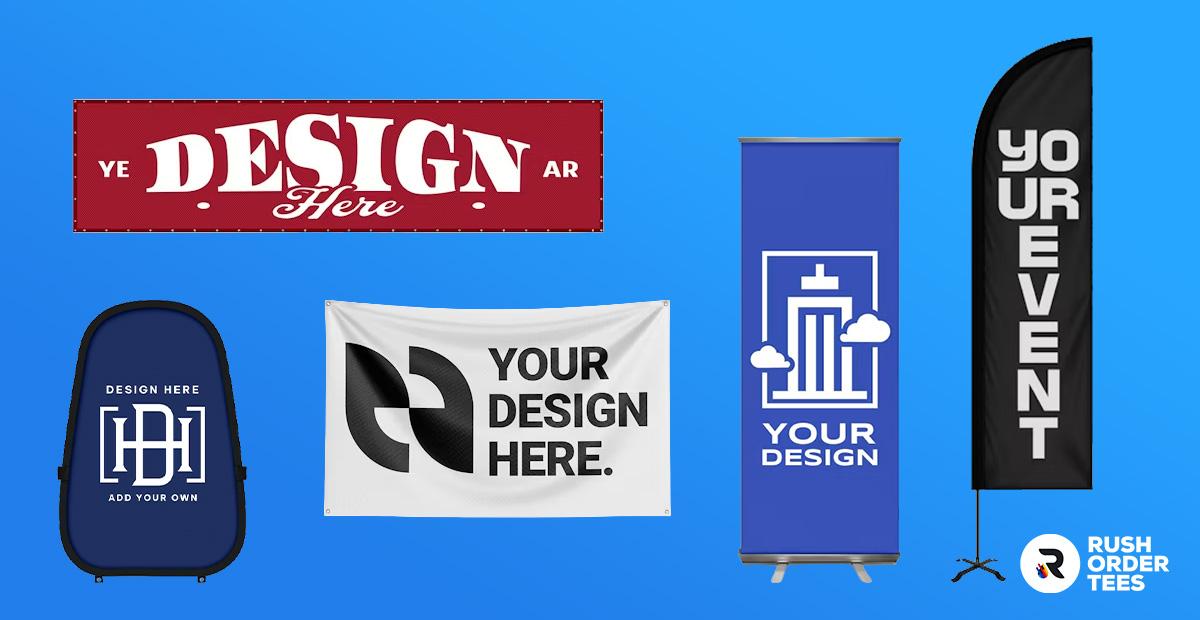
- Vinyl banners are the workhorse format, printed on 13 oz scrim vinyl that handles weather, UV, and rough handling. An 18 oz heavy-duty option exists for long outdoor runs and double-sided pole banners.
- Mesh banners look similar but are perforated, letting wind pass through. They're built for fence wraps, building wraps, and any large outdoor placement where solid vinyl would catch wind like a sail.
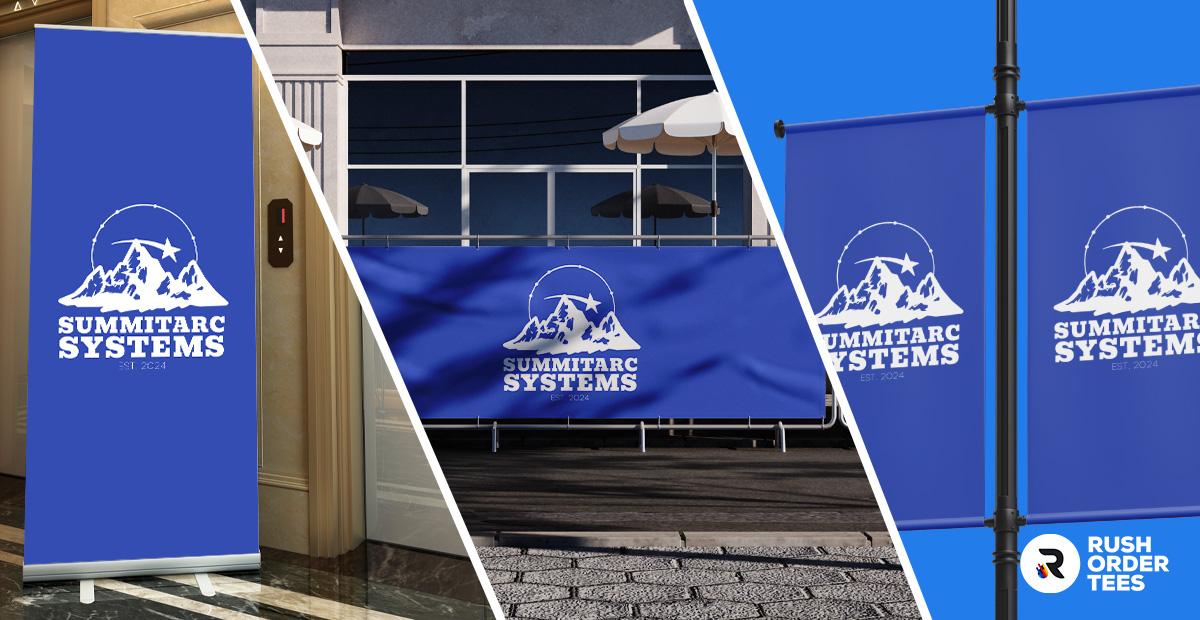
- Retractable banners roll into their own aluminum base, which makes them the default for trade shows and conference floors.
- Pop-up banners take that idea further with a tension-fabric backdrop on an expanding frame.
- Fabric banners, custom flags, and gonfalons cover the more decorative end, including parades, graduations, and branded entrances.
Standard Banner Sizes: Quick Reference
Most banner sizes come in 1:2 aspect ratios because that's how the material is made. Standard vinyl rolls come in 36", 48", and 60" widths, and the most popular dimensions align cleanly with those rolls to keep material waste low and pricing reasonable.
- 2' x 4' — Tabletop displays, checkout counters, small directional signs. Readable up to 15 feet.
- 3' x 6' — Storefronts, window displays, event booths, fence banners. Readable from 20–30 feet.
- 4' x 8' — Outdoor advertising, grand openings, construction sites. Readable from 30–50 feet.
- 5' x 10' — Stage backdrops, large events, trade show backwalls. Readable from 50–75 feet.
- 6' x 12' — Building wraps, sports venues, sidewalk-visible storefronts. Readable from 75–100+ feet.
- 8' x 8' / 10' x 10' — Step-and-repeat backdrops, stage walls, photo booths. Designed for close-up viewing (5–15 feet).
The reliable rule of thumb for matching banner size to viewing distance is one inch of letter height per ten feet. A banner read from 30 feet needs three-inch letters; a banner read from a parking lot 100 feet away needs at least ten-inch letters. Since the largest text on a banner usually takes up roughly one-sixth of the banner's height, that math works backward to a practical minimum size. If you need ten-inch letters to be legible, you're looking at a 4'x8' or larger.
A quick note on orientation: horizontal banners are the default and work best across windows, fences, storefronts, and event tables. Vertical layouts fit narrow vertical spaces, get mounted on light poles for street campaigns, or serve as retractable-style standees indoors. Square banners (typically 8'x8' or 10'x10') sit in their own category — almost always used as photo backdrops, step-and-repeats, or stage walls where the camera frame or audience sightline is closer to a square than a wide rectangle. The same dimensions in different orientations are not interchangeable. A 3'x6' horizontal reads as a wide headline; flipped vertically, it becomes a tall poster.
How to Choose the Right Banner Size
Picking the right one comes down to four questions:
- How far away will people read it? Apply the 1"/10ft rule. If your banner needs to be readable from 50 feet, plan for at least five-inch lettering, which usually means a banner at least four feet tall. Cars at 30 mph and pedestrians at walking speed have very different windows of attention, so err on the larger side if there's any doubt.
- Where exactly will it go? Wall-mounted, fence, storefront window, freestanding stand, or stage backdrop—each placement carries its own constraints. Measure the actual space, including margin for mounting hardware (grommets, zip ties, ropes, banner stands). Fence banners over 4'x8' usually need mesh material to handle wind. Indoor placements behind a counter or in a window have ceiling and frame limits to respect.
- How much content is on it? A logo and three-word tagline fits comfortably on a 2'x4'. Add a phone number, a website, an offer, and a deadline, and you'll need at least 3'x6' to keep the layout from feeling crowded. The general principle: every additional content element roughly doubles the canvas you need to display it cleanly.
- Horizontal, vertical, or square? Horizontal is right for wide spaces, storefronts, fence runs, and most event tables. Vertical works for narrow walls, light poles, retractable stands, and anywhere ceiling height matters more than wall width. Square dimensions (8'x8' or 10'x10') are purpose-built for photo backdrops and stage step-and-repeats, where you want even framing on both sides of the subject. If you're planning around a retractable banner, you're locked into vertical: stands hold graphics that are roughly 24" to 48" wide and 80" to 92" tall.
Banner Sizes by Use Case
Different events and businesses gravitate toward specific sizes. Here's where the most common ones land:
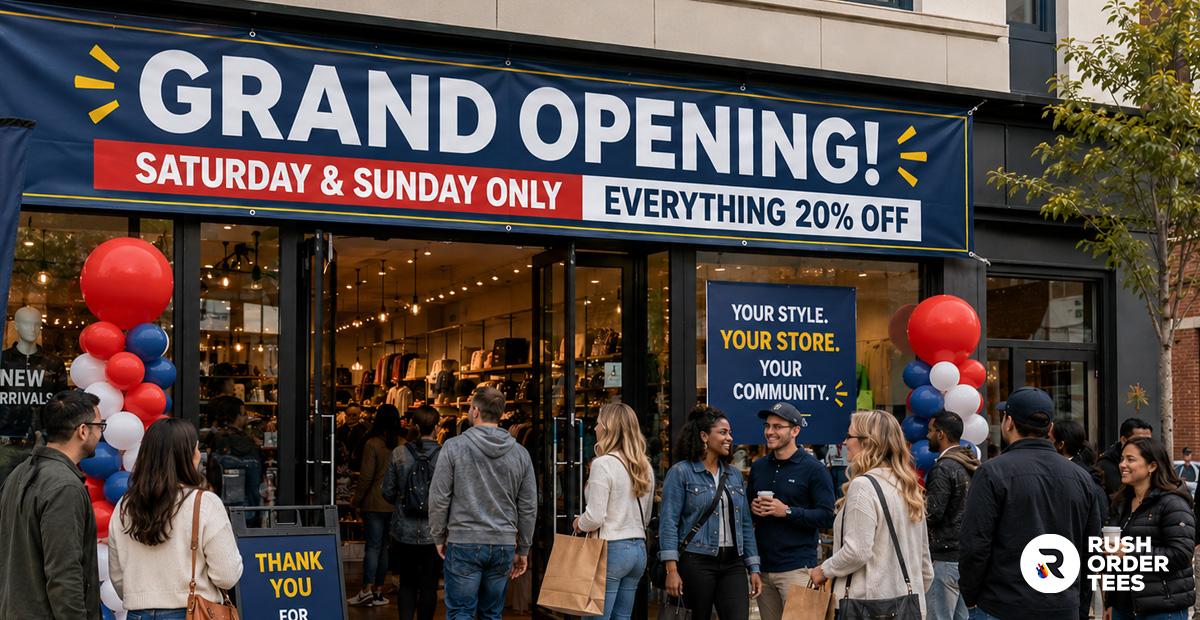
- Business advertising. Grand openings, sales, and storefront promotions usually call for a 3'x6' or 4'x8'. The 4'x8' wins outdoors when the banner has to compete with traffic, parking lot signage, and storefront glare; the 3'x6' is plenty for window displays or quick-turn promotions.
- Birthdays, weddings, and private events. A 3'x6' is the workhorse here, big enough to anchor a backdrop or hang above an entryway without overwhelming a venue. Step up to 5'x10' for a stage backdrop or a head-table banner.
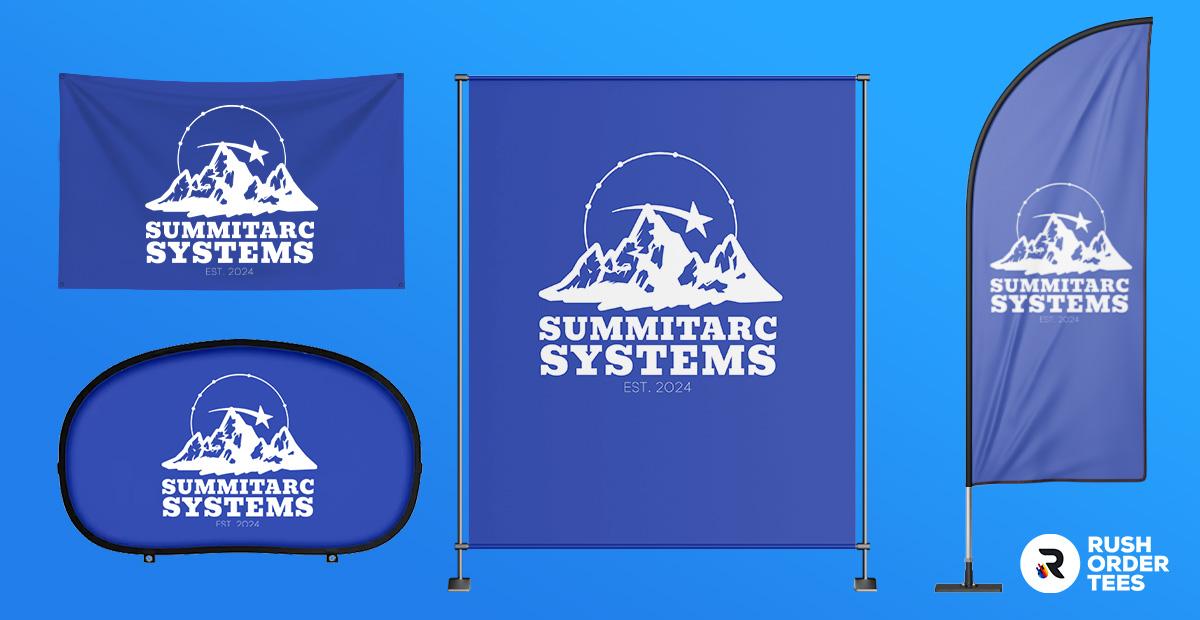
- Trade shows and conferences. Retractables in the 33"x81" range fit neatly inside the standard 10'x10' booth most shows allocate, which is why they dominate the floor. For larger booths, pop-up banners and 4'x8' backdrop banners create a finished booth wall. Booth-side directional and product display signs round out the setup, and the full lineup lives on our trade show displays page.
- Sports and school banners. Gym-wall championship banners and fence banners along baseball or soccer fields run anywhere from 3'x6' for individual team recognition up to 6'x12' for stadium-scale displays. Mesh material is the default for any outdoor field placement to handle wind.
- Step-and-repeat backdrops. Photo backdrops for fundraisers, premieres, and corporate events run square at 8'x8' or 10'x10', or rectangular at 8'x10' for wider group shots. These typically print on polyester fabric rather than vinyl because dye-sublimation produces richer color and reduces flash glare in photographs.
- Flags, gonfalons, and ceremonial banners. Vertical formats work for parades, processions, and indoor ceremonies. Custom flags handle outdoor pole displays, and gonfalons lend a formal, hanging-banner look to graduations, churches, and academic settings.
Custom Banner Sizes vs. Standard Sizes
Standard sizes cover most banner needs because they evolved alongside the material widths and the standard installation hardware. They're faster to produce, cheaper because of material efficiency, and easier to plan for since stand widths, replacement graphics, and shipping cartons are all built around them.
Custom sizes earn their place in three situations. First, unusual mounting spaces, like a banner that has to fit between two columns or below an awning at an exact height. Second, brand systems with specific aspect ratios baked into the design templates, where forcing a 3:6 layout would crop a logo or break the visual hierarchy. Third, oversized installations, like building wraps or arena-scale banners that simply exceed the standard chart.
The good news for custom orders: there's no minimum at our shop, so a single one-off custom banner costs about the same per square foot as ordering ten. The Design Studio will preview your dimensions at scale before you commit, which catches the most common custom-sizing mistake (not leaving enough space for grommets and hem).
Banner Design and Ordering Tips
A few habits separate clean banner orders from frustrating ones:
- Keep messaging short. A headline, a subline, and a call to action is plenty. Banners aren't billboards, brochures, or websites; they're glance-and-move signage. If your message takes more than three seconds to read, the banner is doing too much.
- Run a contrast check. Dark text on light background, or light text on dark background. Anything in between fails at distance, in low light, or under a parking lot lamp.
- Match material to placement. Indoor banners can use 13 oz vinyl without issue. Outdoor banners, especially anything mounted on fences, should switch to mesh banners once you go above roughly 4'x8'. Wind load on solid vinyl at that size will tear grommets out of the hem.
- Measure twice, order once. Account for mounting hardware, hem allowance, and clearance from adjacent walls or ceilings. A 4'x8' banner with grommets needs about 4'1" of horizontal mounting clearance to hang flat.
- Preview before printing. The Design Studio shows your finished banner at actual scale. Use it to catch crowded layouts, tiny logos, and any text that disappears at viewing distance.
Get the Right Banner Without the Guesswork
Standard banner sizing comes down to three things: how far away your audience will be, how much you're trying to communicate, and how much space you have to work with. The chart in this guide covers the dimensions you'll see at most print shops, the rule-of-thumb math takes care of legibility, and the use-case section narrows the choices when the chart feels overwhelming. Custom sizing is there when none of the standards quite fit.
When you're ready to order, RushOrderTees handles banners the same way we handle custom apparel: with no minimums, fast turnaround for last-minute events, free shipping, and a satisfaction guarantee on every order. Preview your banner at actual scale before you commit, which is the single best way to avoid the postage-stamp-on-a-storefront problem we mentioned.
Browse the full signs and banners catalog for vinyl, mesh, retractable, pop-up, and ceremonial formats, and jump straight into the Design Studio to mock up your layout at any standard size. The right banner is one good measurement and a few clicks away.

About the Author
A graduate of the Multimedia program at the University of the Arts in Philadelphia, Imri Merritt is an industry veteran with over 20 years of graphic design and color separations experience in the screen printing industry.